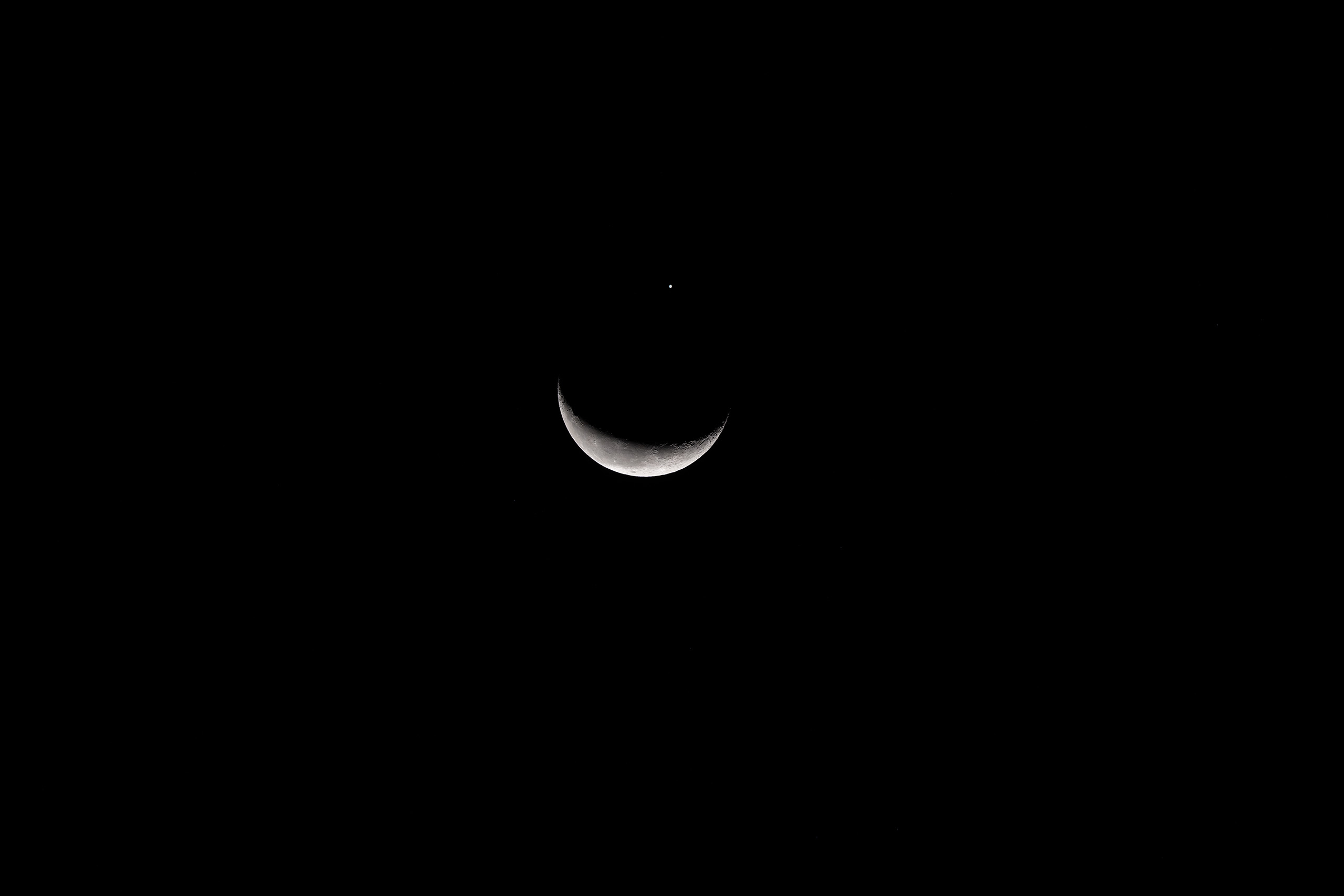
The Hunter’s Moon is the full Moon after the Harvest Moon. This year it was full at 12:11:49 AM EDT on Monday, October 26, 2026, high in the southeast over our home near Blairsville, Georgia, about 67 degrees above the horizon.
That moment is calculated, not seen. The Moon does not look any different at 12:11:49 than it did a few minutes before or after. But it is a real moment, and we wanted to be watching when it came.
How we filmed it
A Nikon Z7 with a 500mm lens on a video head, tracker off, recording 4K video. With no tracker, the Earth’s turning carries the Moon across the frame. At 500mm it drifts about a quarter of a degree a minute, roughly its own width every two minutes, so it takes about twenty minutes to cross from one corner to the other.
We started recording at 11:57 PM and let the Moon cross once. At about 12:09 we aimed again, and it crossed a second time; in the film the two passes are joined with a dissolve. The instant of full Moon falls 14 minutes 19 seconds into the original clip, with the Moon near the middle of the frame. The camera clock was set to the second before the shoot and had drifted only two seconds by the next morning.

What we got wrong
The camera was tipped. Aimed high into a black sky there is no horizon to line up against, and the frame ended up turned about a third of the way toward vertical. We only found out by measuring the Moon’s path in the footage: it climbed steeply across the frame instead of running corner to corner. So the Moon’s face in this video sits rotated from how it looked in the sky. Nothing else about it is changed. Next time: level the tripod head, line up the lens collar’s marks, check the camera’s electronic level while aimed low, then tilt up.
The sound
The sound is the night itself. A steady, wavering tone runs through the whole recording, between about 3,000 and 3,400 cycles a second, pulsing slowly and fading a little over the twenty minutes: insects, still singing at midnight at the end of October. Now and then something passes far off, a vehicle or a plane. In the film the insects carry on quietly under the music and have the last word; the final minute of night sound comes from earlier in the same recording, because the camera stopped soon after the Moon left the frame.
Field Captured: real footage, real time, nothing generated. Times calculated with Skyfield and the JPL DE421 ephemeris.